


 Syndicate
Dotnetcat » .NET Books » VB.NET books
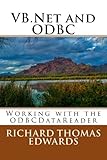
VB.Net and ODBC: Working with the ODBCDataReader
|
Author: | Richard Thomas Edwards |
| Publisher: | CreateSpace Independent Publishing Platform ( 8 July 2018) | Price: |
This book is about working with the ODBC DataReader and shows you how to get the most effective use of it providing you with a suite of output options already coded for you so you can cut and paste the code into your next VB.Net Project.
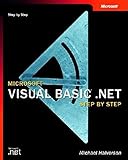
Microsoft Visual Basic .Net Step by Step (Step by Step (Microsoft))
|
Author: | Michael Halvorson |
| Publisher: | Microsoft Press ( 1 January 2002) | Price: |
Here's a fast way for any programmer to begin writing professional Microsoft Windows-based applications for the Microsoft .NET platform-and extend them to the Web-one step at a time. Halvorson shows how to unleash the power of the new, Web-integrated version of Visual Basic, with coverage of object-oriented design strategies and the creation of Web Forms and Web Services.
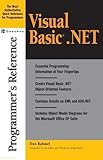
Visual Basic .NET (Programmer's Reference)
|
Author: | Dan Rahmel |
| Publisher: | McGraw-Hill Professional (16 May 2008) | Price: |
This guide provides developers with an overview of the .NET framework. It reviews new applications types, describes and illustrates new operations and presents the 37 new switches that control the program compilation settings.
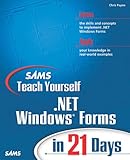
Sams Teach Yourself .NET Windows Forms in 21 Days
|
Author: | Chris Payne |
| Publisher: | Sams Publishing (23 May 2002) | Price: |
.NET Windows Forms are a new programming paradigm introduced with Microsoft's .NET initiative. Windows Forms are very similar to Web Forms, which allow programmers to build complex Web application interfaces easily, sharing the same underlying framework and programming concepts. Windows Forms, however, are used for the Win32 platform, instead of the Internet, and allow programmers to build traditional Windows desktop-based applications structured around .NET.
Sams Teach Yourself .NET Windows Forms in 21 Days covers all the major aspects of Windows Forms necessary to build professional, functional applications. This book follows the tried-and-tested 21 Days tutorial model to guide the reader through Windows Forms. It features code examples and tips for programmers migrating from pre-Windows Forms Microsoft technologies.
The reader will be introduced to the many controls available for .NET Windows Forms and how to build them, learn how to create events and event…
Programming Fundamentals Using Microsoft Visual Basic .NET
|
Author: | Gary B. Shelly |
| Publisher: | Course Technology ( 9 September 2004) | Price: |
This introduction to programming text provides students taking a programming logic or computer concepts course with the fundamentals of key programming concepts, an introduction and discussion of programming code, and the opportunity to apply knowledge learned using Visual Basic .NET.
Microsoft ADO.NET 4 Step by Step (Step by Step Developer)

|
Author: | Tim Patrick |
| Publisher: | Microsoft Press ( 4 November 2010) | Price: |
Teach yourself the fundamentals of ADO.NET 4 -- one step at a time. With this practical, learn-by-doing tutorial, you get the clear guidance and hands-on examples you need to start creating datacentric applications for Windows and the Web.
Discover how to:
- Connect to external data sources, including databases and other data formats
- Use ADO.NET Entity Framework to interact with underlying data stores
- Build Entity Framework models with graphical design tools in Microsoft Visual Studio 2010
- Analyze information stored in ADO.NET with various LINQ providers
- Bind data directly to Windows Forms and Web Forms to drive information to users
- Manage disconnected or standalone data and information
- Go beyond the core functionality of ADO.NET to manipulate data in more advanced ways
Your step by step digital content includes:
- Practice exercises
- Fully searchable online edition of this book…
Advanced VB.NET Alternate with VB.Net CD's (3rd Edition)
|
Author: | Kip Irvine |
| Publisher: | Addison Wesley (21 June 2005) | Price: |
This book takes those who are familiar with the basics of Visual Basic.NET programming, and helps them understand how to harness its power for more advanced uses. Coverage of various database, ASP, and Web Services topics is provided in the same understandable way that has made Tony Gaddis' books leaders in the field. This is recommended for readers who have a foundational understanding of Visual Basic.NET.
ADO.NET in a Nutshell
|
Author: | Matthew MacDonald |
| Publisher: | O'Reilly Media ( 1 April 2003) | Price: |
Written by experts on the Microsoft® .NET programming platform, ADO.NET in a Nutshell delivers everything .NET programmers will need to get a jump-start on ADO.NET technology or to sharpen their skills even further. In the tradition of O'Reilly's In a Nutshell Series, ADO.NET in a Nutshell is the most complete and concise source of ADO.NET information available.ADO.NET is the suite of data access technologies in the .NET Framework that developers use to build applications services accessing relational data and XML. Connecting to databases is a fundamental part of most applications, whether they are web, Windows®, distributed, client/server, XML Web Services, or something entirely different. But ADO.NET is substantially different from Microsoft's previous data access technologies--including the previous version of ADO--so even experienced developers need to understand the basics of the new disconnected model before they start programming with it.Current with the…
C# & VB.NET Conversion Pocket Reference: Converting Code from One Language to Another
|
Author: | Jose Mojica |
| Publisher: | O'Reilly Media ( 2 May 2002) | Price: |
Though most programmers use two or more languages, they usually have a mastery of one. Although Microsoft has advertised that the .NET runtime is language agnostic and that C# and Visual Basic .NET are so close that switching between the two is really quite easy, that?s only true up to a point. Some of the differences are obvious, but others are very subtle. C# & VB.NET Conversion Pocket Reference helps you easily make the switch from one language to another.The differences occur in three main areas: syntax, object-oriented principles, and the Visual Studio .NET IDE. Syntax concerns the statements and language elements. Object oriented differences are less obvious, and concern differences in implementation and feature sets between the two languages. IDE differences include things like compiler settings or attributes. There is also a fourth area of difference: language features that are present in one language but have no equivalent in the other. These unique language…
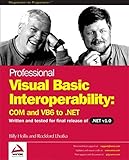
Professional Visual Basic Interoperability - COM and VB6 to .NET
|
Author: | Billy Hollis |
| Publisher: | Apress ( 1 February 2002) | Price: |
Covers COM interoperability in detail, and broadens the focus to examine a range of issues that must be handled in order for VB6 and COM code to run on .NET. Aimed at experienced Visual Basic developers who need to make COM and VB6 code interoperate with the new .NET platform. Softcover.